Research

AI. Quantum. Communication.

Explore our work in artificial intelligence, quantum optimization, and wireless communication.

ARTIFICIAL INTELLIGENCEQUANTUM COMPUTINGWIRELESS COMMUNICATION
  1. Artificial IntelligenceAI for networks, and networks for distributed intelligence.2 topics
  2. Quantum ComputingQuantum optimization for problems in communication systems.1 topic
  3. Wireless CommunicationWireless foundations, flexible radio environments, and trustworthy links.5 topics

Research direction

Artificial Intelligence

AI for networks, and networks for distributed intelligence.

How can learning run efficiently across many devices when every model update has to cross a wireless link?
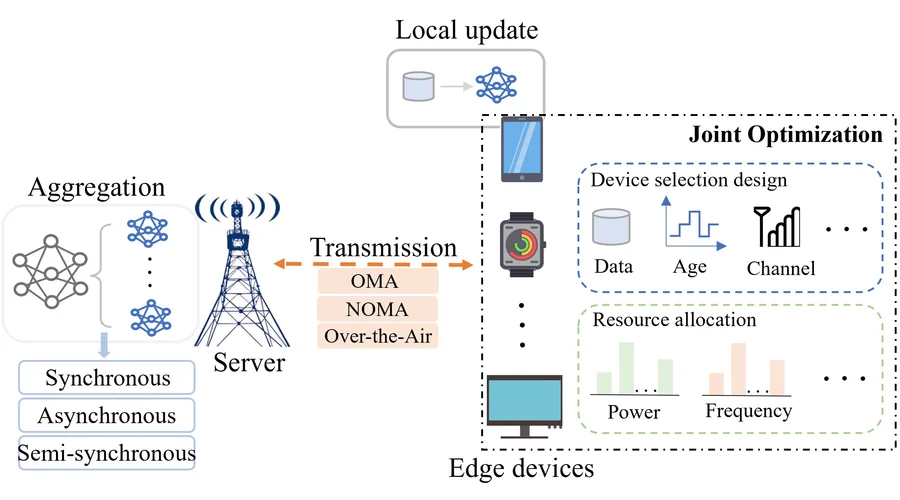
Diagram of edge devices training local models and exchanging parameters with an aggregation server

Artificial Intelligence

Communication-Efficient Edge AI

Federated, hierarchical, digital-twin-assisted, and task-oriented learning designs that reduce the cost of exchanging model updates over wireless links.

Approach and research aims

Edge artificial intelligence (AI), a fusion of edge computing and AI algorithms, has attracted significant research interest in recent years. Unlike traditional cloud-based AI, which relies on centralized processing of raw data, edge AI enables distributed data processing and decision-making directly at the device level, effectively mitigating the risk of data leakage. Edge AI also offers reduced latency and improved energy efficiency, making it well-suited for responsive applications such as industrial IoT, autonomous vehicles, and smart home systems. In edge AI systems, devices perform local model training using their own data and upload the trained model parameters to a coordinating server responsible for global model aggregation and distribution. However, the frequent parameter exchange between devices and the server poses challenges to communication and training efficiency, which are critical to the performance of edge AI systems.

Research aims

  1. Communication-efficient Federated Learning (FL) and Hierarchical FL (HFL) over NOMA networks: strategies to optimize communication overhead.
  2. Digital-twin-assisted FL systems: leveraging digital twins to enhance training efficiency and improve resource utilization.
  3. Task-oriented edge AI systems: solutions tailored to diverse task requirements across devices to ensure strong performance and resource allocation.
Related publications

Related projects

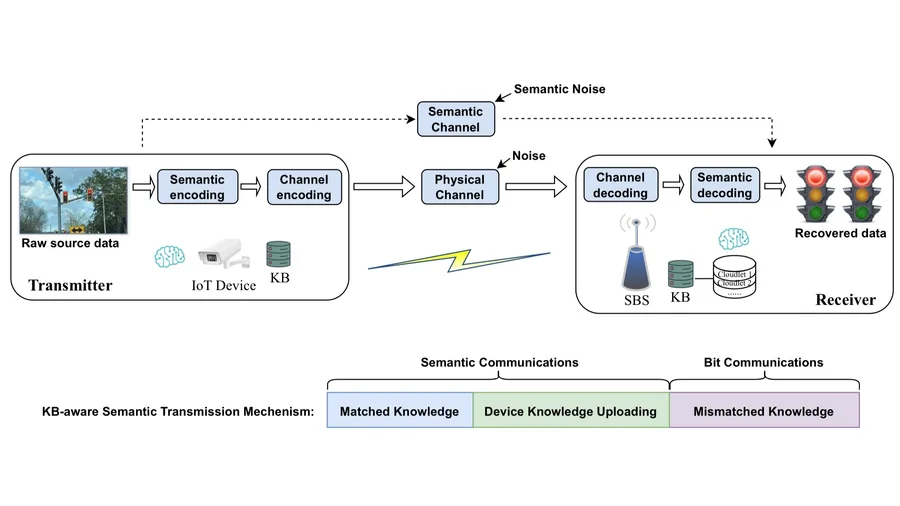
Diagram of a semantic communication system with shared knowledge bases at transmitter and receiver

Artificial Intelligence

Semantic Communications

Exchanging the meaning extracted from messages, using knowledge bases shared by transmitter and receiver, rather than transmitting the raw bit stream.

Approach and research aims

Benefitting from advancements in micro-electronics and artificial intelligence, recent developments in machine learning and end-to-end communication technologies are driving the transformation of traditional communication systems toward future paradigms. Semantic communications, as an emerging intelligent communication paradigm, focus on exchanging the meaning or semantics extracted from messages rather than transmitting the raw bit stream directly. By leveraging shared knowledge bases (KBs) between the transmitter and receiver, more meaningful semantic information is extracted from the source data before semantic and channel encoding at the transmitter. The receiver recovers the source information by semantic restoration through channel and semantic decoding. This approach has shown significant potential to address spectrum scarcity and improve communication efficiency.

Research aims

  1. An edge-assisted semantic communications framework for resource-constrained IoT devices, described in the source as the first work to study the semantic extraction model selection problem in an edge-assisted semantic network.
  2. A knowledge-sharing-enabled, task-oriented hybrid semantic-bit communications mechanism for multi-cell networks to tackle knowledge-base mismatch.
  3. A collaborative knowledge-sharing semantic-bit mechanism that maximizes a derived generalized effective semantic transmission rate in two-tier edge networks.

Related publications

Related projects

Research direction

Quantum Computing

Quantum optimization for problems in communication systems.

How can large combinatorial problems fit on today’s qubit-limited quantum hardware without giving up solution quality?
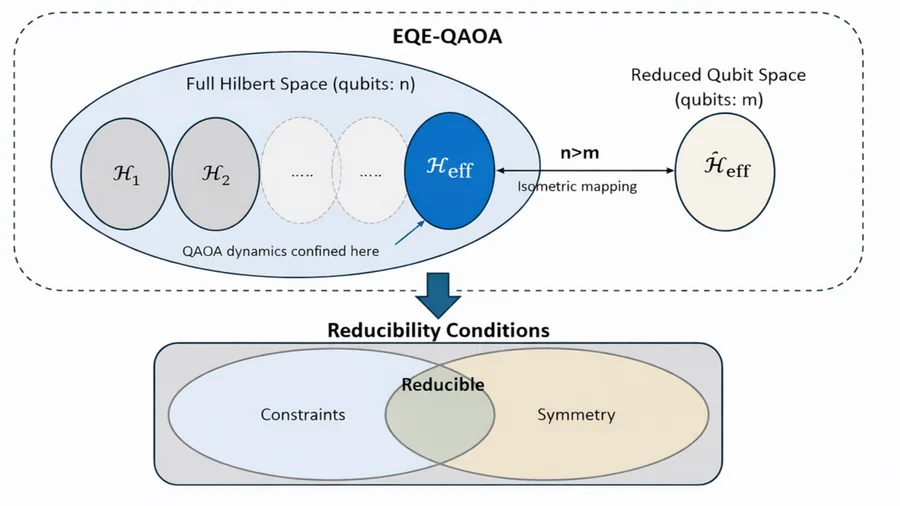
Diagram of the qubit-efficient quantum computing approach to combinatorial optimization

Quantum Computing

Qubit-Efficient Quantum Computing

Reducing the qubit requirements of the Quantum Approximate Optimization Algorithm (QAOA) while preserving optimization performance.

Approach and research aims

Quantum Computing (QC) has emerged as a promising approach for solving combinatorial optimization problems by exploring exponentially large solution spaces. It provides compelling global search capabilities, potentially capable of outperforming classical heuristics in finding high-quality solutions. However, the limited number of qubits is a major bottleneck in QAOA for large-scale combinatorial optimization in the Noisy Intermediate-Scale Quantum (NISQ) era. Existing qubit reduction methods typically trade off performance for efficiency, as they introduce information loss and degrade solution quality. A key challenge is therefore how to reduce qubit requirements while preserving the original optimization performance.

Research aims

  1. Qubit reduction based on conserved quantities and symmetry-constrained quantum dynamics, which restrict the evolution to an invariant subspace.
  2. Isometric encoding strategies for representing this subspace with fewer qubits.
  3. Applicability conditions and scalability for large-scale optimization problems in engineering.

Related publications

Research direction

Wireless Communication

Wireless foundations, flexible radio environments, and trustworthy links.

How should antennas, surfaces, power, and access be configured so that many users share a channel efficiently and securely?
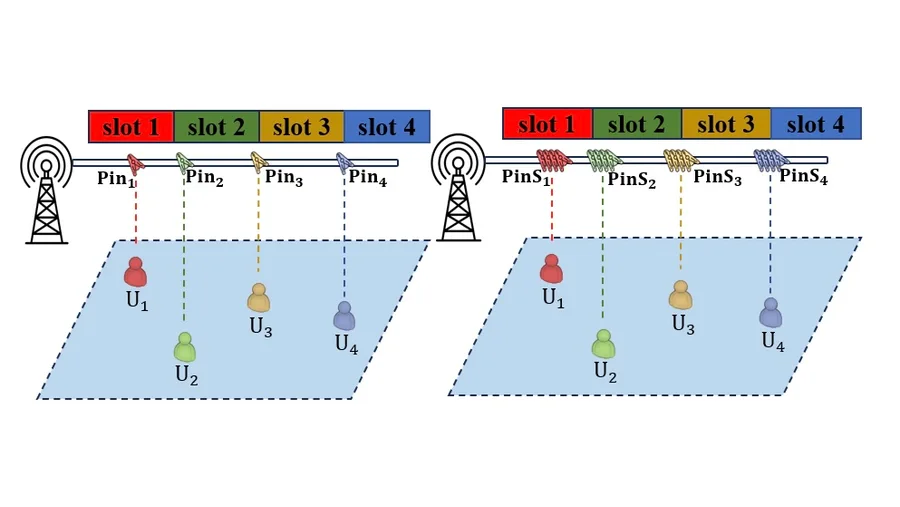
Illustration of a pinching-antenna system with dielectric elements placed along a waveguide near users

Wireless Communication

Pinching Antenna Systems

A low-cost, reconfigurable flexible-antenna approach: small dielectric elements placed along a waveguide create antennas close to users.

Approach and research aims

Pinching antenna technology is a promising direction in flexible-antenna systems, offering a low-cost and reconfigurable approach to improve wireless communication. Unlike traditional antennas with fixed positions, pinching antennas are created by placing small dielectric elements along a dielectric waveguide. This setup allows antennas to be positioned close to users, which helps establish strong line-of-sight links and reduce large-scale path loss. The system supports multiple antennas on a single waveguide at no extra hardware cost and aligns well with techniques like non-orthogonal multiple access (NOMA) by enabling signal superposition. With the ability to adjust antenna placement to reconfigure channel conditions, pinching antennas provide an efficient and scalable solution for future wireless networks, especially in indoor and dense-user scenarios.

Research aims

  1. Low-complexity optimization of pinching antenna placement.
  2. Blockage modeling in pinching-antenna-assisted networks.
  3. AI-empowered pinching antenna systems.

Related publications

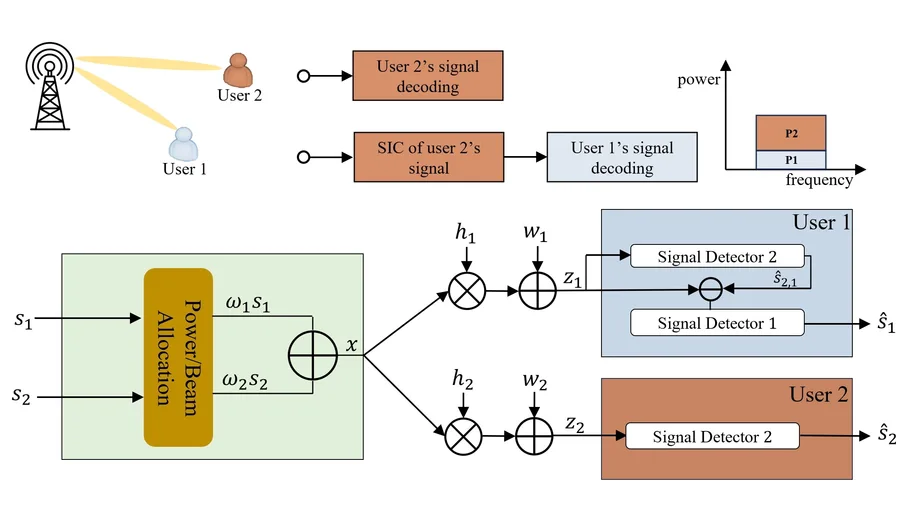
Diagram of NOMA users sharing a resource block with different power levels and successive interference cancellation

Wireless Communication

Non-Orthogonal Multiple Access (NOMA) Communications

Letting multiple users share the same resource block through power-domain multiplexing and successive interference cancellation (SIC).

Approach and research aims

Non-Orthogonal Multiple Access (NOMA), introduced for 3GPP LTE-Advanced, presents a promising solution to the challenges faced by 5G networks by enabling multiple users to share the same orthogonal resource block. This approach improves spectrum efficiency compared to traditional Orthogonal Multiple Access (OMA). The key idea behind NOMA is to exploit differences in users’ channel conditions. By allocating different power levels to users based on their channel quality, NOMA ensures that signals intended for different users can be separated using successive interference cancellation (SIC) at the receiver.

Research aims

  1. Optimization of beamforming, phase adjustment, and power distribution in a multi-cluster RIS-NOMA system.
  2. Minimization of power consumption in downlink hybrid NOMA networks.
  3. Minimization of power consumption in NOMA networks where semantic and bit-based users coexist.

Related publications

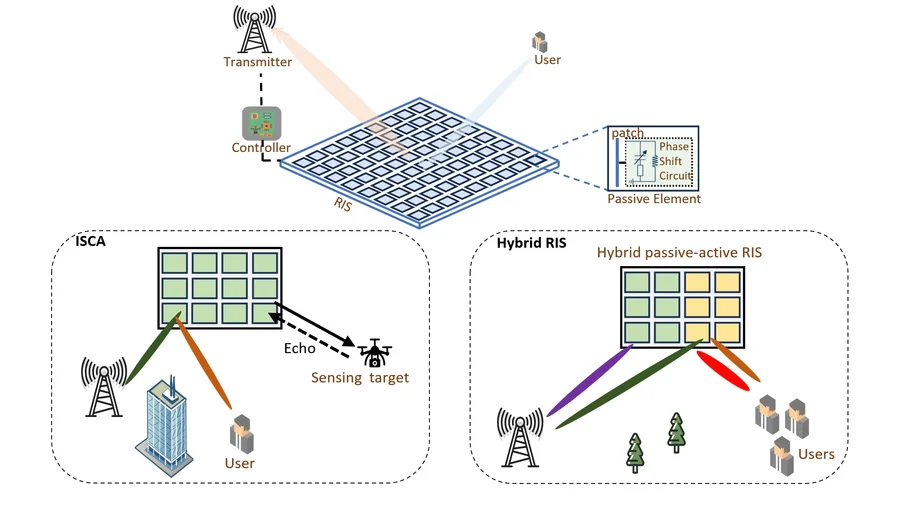
Diagram of a reconfigurable intelligent surface reflecting signals to legitimate users while limiting eavesdroppers

Wireless Communication

Reconfigurable Intelligent Surfaces (RISs)

RIS-aided physical-layer security: beamforming, deployment, and hybrid active/passive surfaces for secure 6G links, including integrated sensing and communication.

Approach and research aims

Sixth-generation (6G) networks face serious security risks due to the broadcast nature of wireless channels, large amounts of privacy-sensitive data, and growing attack vectors. Physical layer security (PLS) secures legitimate transmissions by exploiting the dynamic characteristics of wireless communications. Reconfigurable intelligent surfaces (RISs) turn traditional wireless networks into smart radio environments without large costs or added complexity, and RIS-aided PLS solutions can be applied to 6G technologies such as multi-access edge computing (MEC), integrated sensing and communication (ISAC), and NOMA.

Research aims

  1. Beamforming design for passive-RIS-aided PLS systems, considering the spatial deployment of the RIS.
  2. The ability of hybrid active/passive RIS to enhance secure performance.
  3. Using RISs to enhance the secure performance of integrated sensing and communication (ISAC).

Related publications

Related projects

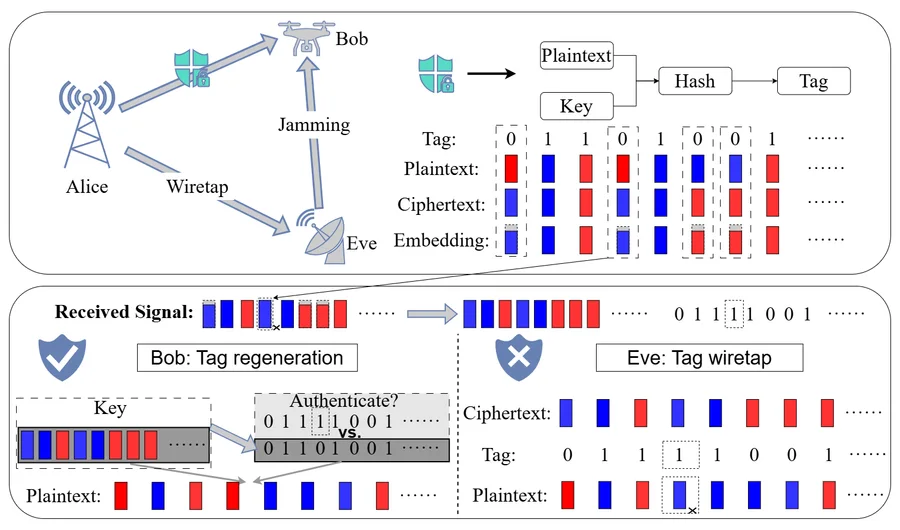
Diagram of physical-layer secrecy and authentication between legitimate and illegitimate receivers

Wireless Communication

Trustworthy Wireless Communications

Physical-layer mechanisms that achieve secrecy and authentication together, protecting signals from eavesdropping and rejecting unauthorized access.

Approach and research aims

Secure wireless communications face increasing vulnerabilities caused by the open nature of propagation environments, requiring the capability to reject unauthorized access and protect signals from eavesdropping. Various physical-layer mechanisms are potential solutions with the advantages of low latency and high compatibility. Artificial noise (AN) and precoding (beamforming) can differentiate legitimate and illegitimate receptions to achieve a secrecy rate, and authentication verifies transceivers based on hardware impairments, channel characteristics, or an artificial fingerprint (tag).

Research aims

  1. A dual-reference symmetric tag serving as the reference for one-time-pad encryption and for tag-embedding authentication.
  2. Extracting accurate channel attributes for key generation and channel-based authentication.
  3. Uniquely decomposable constellations with cooperative message and tag transmission.

Related publications

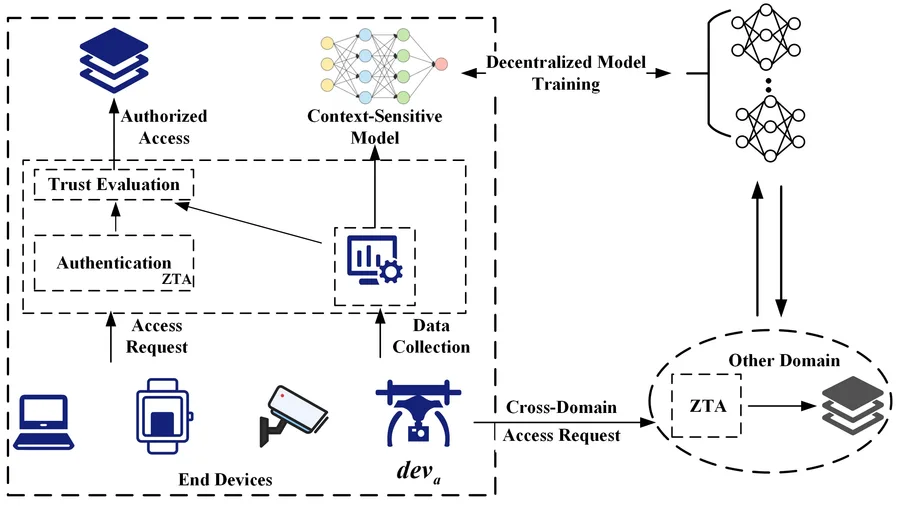
Diagram of a decentralized zero trust architecture across IoT domains

Wireless Communication

Decentralized Zero Trust Authentication and Authorization

Continuous device verification and fine-grained access control for large-scale IoT networks, across domains and without a central authority.

Approach and research aims

Decentralized Zero Trust Authentication and Authorization is a framework designed to enhance the security of large-scale IoT networks. Unlike centralized methods that rely on one-time authentication, it applies the principles of Zero Trust Architecture (ZTA) to ensure continuous device verification and fine-grained access control, mitigating risks such as lateral movement attacks and session hijacking. Implementing decentralized authentication and authorization poses challenges, including efficient communication across domains, preserving data privacy, and adapting to the diverse data characteristics of large-scale IoT networks.

Research aims

  1. Continuous and decentralized access control for intra-domain and cross-domain IoT environments.
  2. Privacy-preserving mechanisms that reduce data transmission by securely sharing essential information.
  3. Real-time adaptability through context-aware evaluation and collaborative learning such as Decentralized Federated Learning (DFL).

Related publications

Read the papers behind the work.